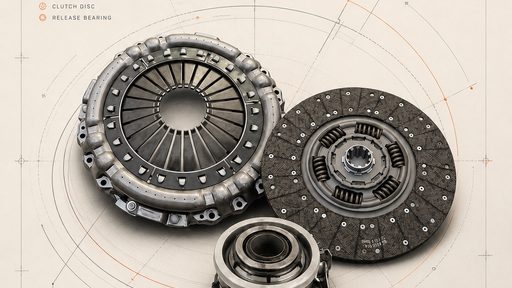


Truck clutch symptoms are useful clues, but they are not complete diagnoses. Slipping, judder, chatter and hard shifting can involve the clutch disc, pressure plate, release system, flywheel, hydraulic or mechanical controls, or the vehicle application itself.
Before ordering a replacement part, record the operating symptom, inspect the complete clutch system and compare the available OE references and dimensions. This guide gives distributors, repair networks and fleet teams a practical starting sequence for discussing a heavy-duty clutch problem with a technical supplier.
Start with the symptom and operating conditions
Write down when the symptom appears rather than describing it only as “bad clutch.” Note whether it occurs during starting, gear changes, reversing, climbing, heavy loading, hot operation or cold operation.
- Does the engine speed rise without a matching increase in vehicle speed?
- Does the vehicle shake when the clutch begins to engage?
- Is gear selection difficult with the pedal fully depressed?
- Does the problem appear after the vehicle warms up?
- Is there noise when the pedal is pressed or released?
- Did the symptom begin after a clutch replacement, conversion or repair?
Operating duty matters. A long-haul truck, construction vehicle, bus and mining vehicle can place different loads on the clutch. Include the application and transmission details when requesting technical support.
Truck clutch slipping
Clutch slipping occurs when the disc cannot transfer the available engine torque without unwanted relative movement between the friction surfaces. A common sign is increasing engine speed without a proportional increase in vehicle speed, especially under load or on an incline.
Possible areas to inspect include:
- Worn or contaminated friction linings
- Oil or grease on the disc friction surfaces
- Insufficient pressure-plate clamping performance
- Incorrect installation height or release adjustment
- Release system components that do not return fully
- Flywheel or pressure-plate surface damage
- A clutch configuration that is not matched to the engine and transmission
Do not assume that replacing the disc alone will solve the problem. Inspect the cover, release system, flywheel and source of any contamination. If oil is present, identify and correct the leak before installing new friction components.
Truck clutch judder and chatter
Judder or chatter is usually felt as vibration or repeated grabbing when the clutch engages. It can appear during take-off, reversing or low-speed maneuvering.
Possible causes include uneven friction surfaces, contamination, excessive runout, incorrect hub orientation, damaged damper components, flywheel condition, installation error or a release system that does not move smoothly.
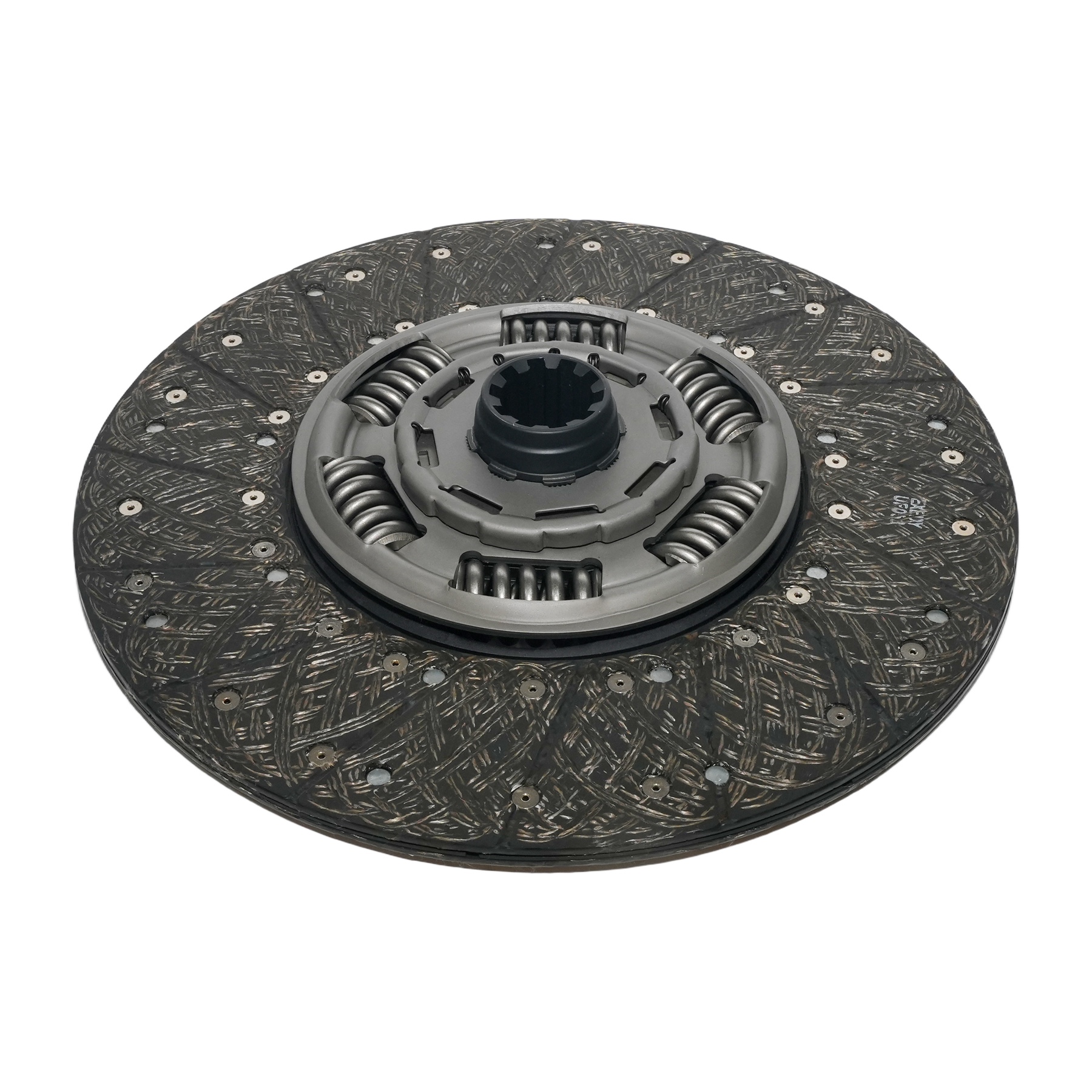
Compare the removed disc’s friction surfaces and hub with the product record. Photograph any heat marks, cracks, broken springs, damaged linings or uneven wear. A close-up photograph cannot replace a complete inspection, but it helps a supplier understand the condition before discussing a replacement.
Hard shifting and clutch drag
Hard shifting or clutch drag occurs when the disc continues to rotate or the release system does not separate the disc sufficiently when the clutch is operated. The symptom may be linked to the release bearing, fork, hydraulic or mechanical control, pressure-plate travel, disc hub condition or incorrect system matching.
Check:
- Whether the pedal or control mechanism provides the required travel
- Whether the release bearing matches the pressure plate interface
- Whether the clutch uses push-type or pull-type operation
- Whether the disc hub can move freely on the transmission spline
- Whether the disc has the correct hub orientation and clearance
- Whether the pressure plate has the correct installation height
If the problem appeared immediately after installation, recheck the part numbers, orientation, mounting pattern and release components before assuming a normal wear issue.
Noise when the clutch pedal is operated
Noise that changes when the pedal is pressed or released can involve the release bearing, pilot support, release fork, pressure plate or another drivetrain component. Record the exact pedal position and operating condition when the sound occurs.
For a B2B product review, send the complete clutch reference, photographs of the bearing interface and details of the transmission. A sound description without application information is rarely enough to select a replacement part.
Diagnostic sequence before ordering
- Record the symptom: describe when it appears and under what load.
- Confirm the application: record the truck, engine, transmission and operating duty.
- Record every reference: photograph markings on the disc, cover and release parts.
- Inspect the complete system: check the disc, pressure plate, release mechanism, flywheel and contamination sources.
- Measure the disc: record diameter, lining dimensions, spline and hub profile.
- Compare the release system: verify push/pull operation, bearing interface and travel.
- Request technical confirmation: send the complete information before ordering a replacement.
Symptom and inspection table
| Symptom | Areas to inspect | Information to send |
|---|---|---|
| Slipping under load | Linings, contamination, clamping, release return and flywheel | Load condition, photos, part numbers and vehicle/transmission |
| Judder or chatter | Friction surfaces, runout, damper, hub orientation and flywheel | Take-off condition, close-up photos and installation history |
| Hard shifting or drag | Release travel, bearing interface, spline, hub clearance and pressure plate | Transmission, control type, dimensions and complete clutch references |
| Pedal-related noise | Release bearing, fork, pilot support and pressure-plate interface | Noise position, pedal condition and release-system photographs |
When a complete clutch kit may be appropriate
If the clutch disc, pressure plate and release system have all been operating in the same vehicle for a long service period, inspect the complete system before choosing one replacement component. A complete kit can reduce the risk of mixing parts with different release directions, installation heights or spline and hub profiles.
The kit still needs to be matched to the actual application. Use the clutch disc measurement checklist and the complete system matching guide before requesting a quotation.
Frequently asked questions
Does clutch slipping always mean the disc is worn?
No. Slipping can also involve contamination, pressure-plate clamping, release adjustment, flywheel condition or a mismatched system. Inspect the complete clutch and the source of the symptom.
Can judder be diagnosed from a product photo?
A photo can show visible damage or contamination, but it cannot confirm every operating cause. Send photos together with the symptom, vehicle, transmission, installation history and measured dimensions.
Why can a new clutch still cause hard shifting?
Possible reasons include incorrect part matching, wrong release direction, insufficient travel, incorrect hub orientation, spline interference or a problem in the vehicle control system. Recheck the complete installation record.
Final checklist
Treat slipping, judder and hard shifting as system symptoms. Record the operating condition, inspect the disc, pressure plate, release system and flywheel, and send the complete application and dimensional record to the supplier.
For a technical review, use the CHUANGJIN Technical Center or send the reference, photographs and measurements through the contact page.
Vehicle and brand names are used for identification and compatibility reference only. Final diagnosis and fitment should be confirmed against the complete vehicle and clutch system.